
An operational assessment that always concludes you need to buy software is a sales pitch disguised as consulting.
In a service company running fifty field technicians, twelve dispatchers, or thirty project coordinators, the most valuable diagnostic result is often a clear instruction to keep your wallet closed.
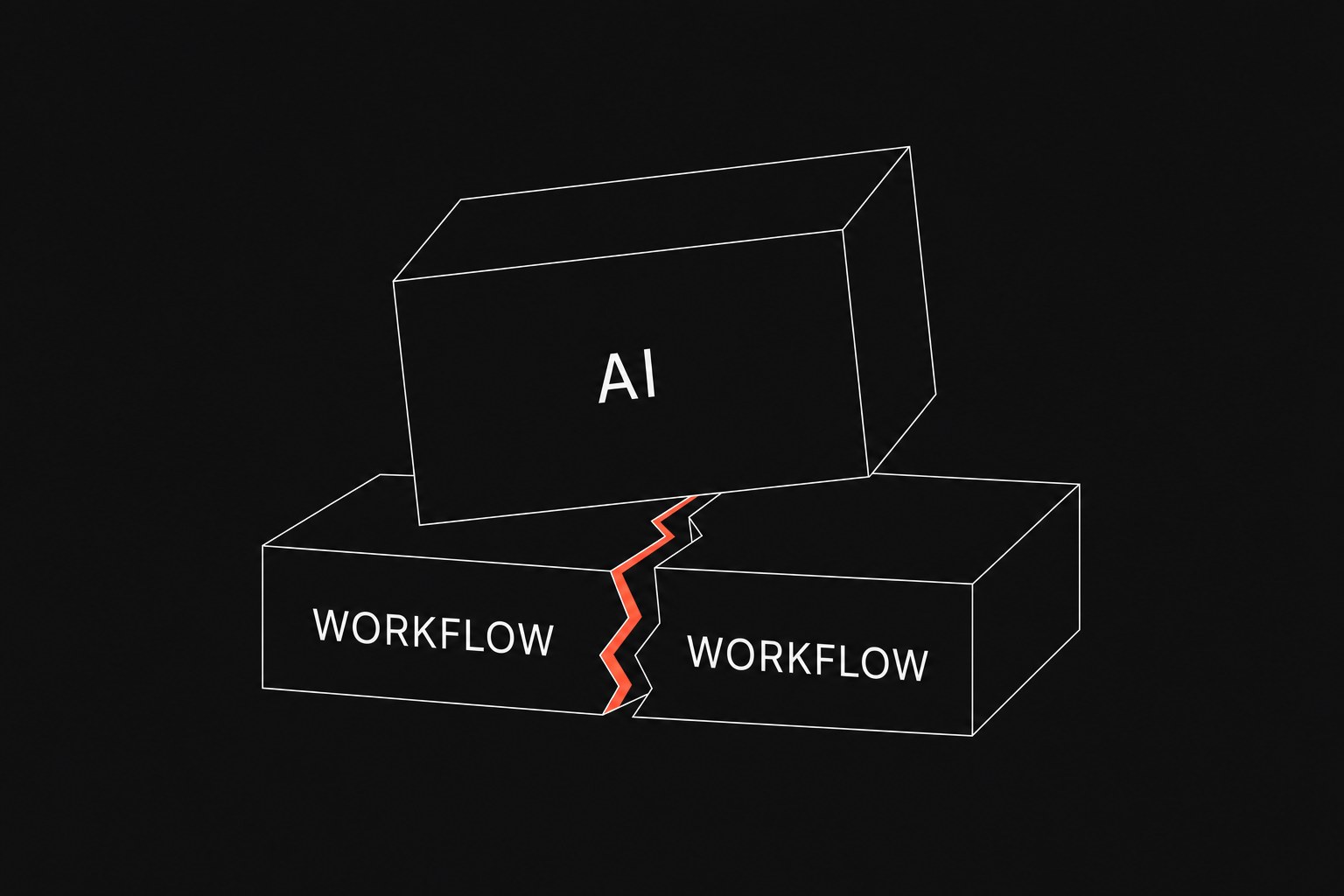
When leadership feels pressure from board members or competitors asking why the business has not rolled out generative tools yet, buying a platform feels like progress. Industry analyses from firms like HSO indicate that between 70% and 80% of AI proofs of concept never reach daily operations because they fail the transition to live field data. If you have not evaluated your baseline through an AI readiness checklist for service businesses, buying software turns into expensive friction.
Before committing budget to machine learning models or probabilistic agents, you must know whether your operational friction stems from an intelligence problem or an unstructured workflow problem. Evaluating AI versus workflow automation usually reveals that simple deterministic scripts solve bottlenecks faster than complex predictive tooling. If your team cannot execute a job consistently on paper, software will not solve it. You have to fix the process before you automate anything.
The four signals that disqualify an AI purchase
A diagnostic review should evaluate how information moves between people and tools. When an assessment examines your field operations and uncovers any of the following four conditions, its primary recommendation should be an explicit refusal to purchase AI software.
1. The underlying workflow has undefined branching logic
Machine learning algorithms require consistent patterns to generate reliable predictions or summaries. If three different dispatchers handle a missed appointment in three completely different ways, an automated tool has no baseline to learn.
Listen to how your team describes exceptions:
- "I usually just text Mark because he knows what that client likes."
- "If the work order looks weird, I hold it until Friday."
- "We do not really have a rule for that; it depends on who is working."
When an operational handoff (work leaving one person or system so another can continue) relies on unwritten personal judgment, inserting software creates errors at scale. You cannot train an algorithm on habits that live only inside someone's head.
2. The core data lacks hygiene and standardization
Proof of concept pilots frequently look successful because vendors run them on clean, curated sample datasets. In live operations, field technicians leave notes blank, coordinators enter phone numbers in address fields, and customer records sit duplicated across three disconnected databases.
If your system of record (the official tool that is supposed to hold the truth) is filled with conflicting customer statuses, an AI assistant reading that data will hallucinate incorrect answers. The assessment must tell you to clean your databases and enforce validation rules before purchasing language models.
3. The bottleneck can be resolved with deterministic rules
Probabilistic models are designed for ambiguous, unstructured inputs like analyzing customer sentiment or transcribing noisy audio. They are the wrong tool for routing tickets based on clear categories, sending appointment reminders, or calculating mileage.
If your operational problem follows standard "if this happens, then do that" logic, buying an AI product introduces unnecessary subscription costs, latency, and hallucination risk. A standard webhook or a simple database trigger handles deterministic work with complete reliability.
4. Downstream staff do not trust the current data flow
If field supervisors already ignore automated schedule notifications because the underlying job runtimes are incorrect, layering an automated recommendation engine on top will provoke active employee resistance. Technology adoption fails when staff spend their afternoons working around the tool rather than working inside it.
The financial cost of automating operational chaos
When a service business purchases tools before standardizing its manual handoffs, the financial waste extends far beyond the monthly software invoice. The true expense includes custom integration retainers, internal coordinator hours lost to auditing incorrect automated outputs, and the labor required to roll back bad records.
The financial drain of premature software purchases compounds across two direct inputs:
Premature Cost = Monthly Platform Fees × Integration and Cleanup Hours
When an assessment identifies broken steps early, it saves that entire calculation from landing on your profit and loss statement.
What a diagnostic review should recommend instead
When an operational assessment rules out buying AI, it should not leave you with empty hands. A rigorous review delivers standard operating procedures, data validation standards, and simple automation blueprints that stabilize the business immediately.
| Assessment Finding | Wrong Recommendation | Correct Operational Recommendation |
|---|---|---|
| Dispatchers assign emergency jobs using undocumented personal preference | Purchase an AI dispatch optimization engine | Document routing rules into a fixed lookup table based on territory and skill |
| Field technician job notes are messy and missing equipment serial numbers | Buy an LLM to parse unstructured text field notes | Add mandatory dropdown fields and photo capture requirements in mobile forms |
| Coordinators spend ten hours weekly manually copying job details to invoices | Deploy an autonomous billing agent | Set up a deterministic webhook between your CRM and accounting software |
| Customer records exist across two unsynchronized systems | Purchase an AI customer data platform | Run a database deduplication sprint and establish one primary system of record |
When buying AI actually makes operational sense
An assessment should recommend deploying AI models only after basic stability criteria are met. If your workflow matches these specific conditions, an AI tool provides immediate leverage:
- Your team receives thousands of messy, multi-paragraph inbound emails or work requests that require extraction into standardized database records.
- Your standard operating procedures are thoroughly documented, but coordinators lose hours searching across hundreds of equipment manuals and compliance documents.
- You already maintain structured customer and job histories, and you want to analyze call transcripts to identify coaching gaps across customer service representatives.
- You have established a deterministic fallback process so a human coordinator can catch and resolve any probabilistic error before it reaches a customer.
If those prerequisites are absent, buying software is an expensive distraction from foundational management work.
Next step
Flaux provides an operational AI assessment that maps your specific service bottlenecks, audits your daily data handoffs, and delivers an objective verdict on whether workflow automation, process cleanup, or an AI purchase is the correct path forward.