
The operations team that waits for a clean quarter before automating will still be pasting the same fields next year, because the firefight already is the calendar.
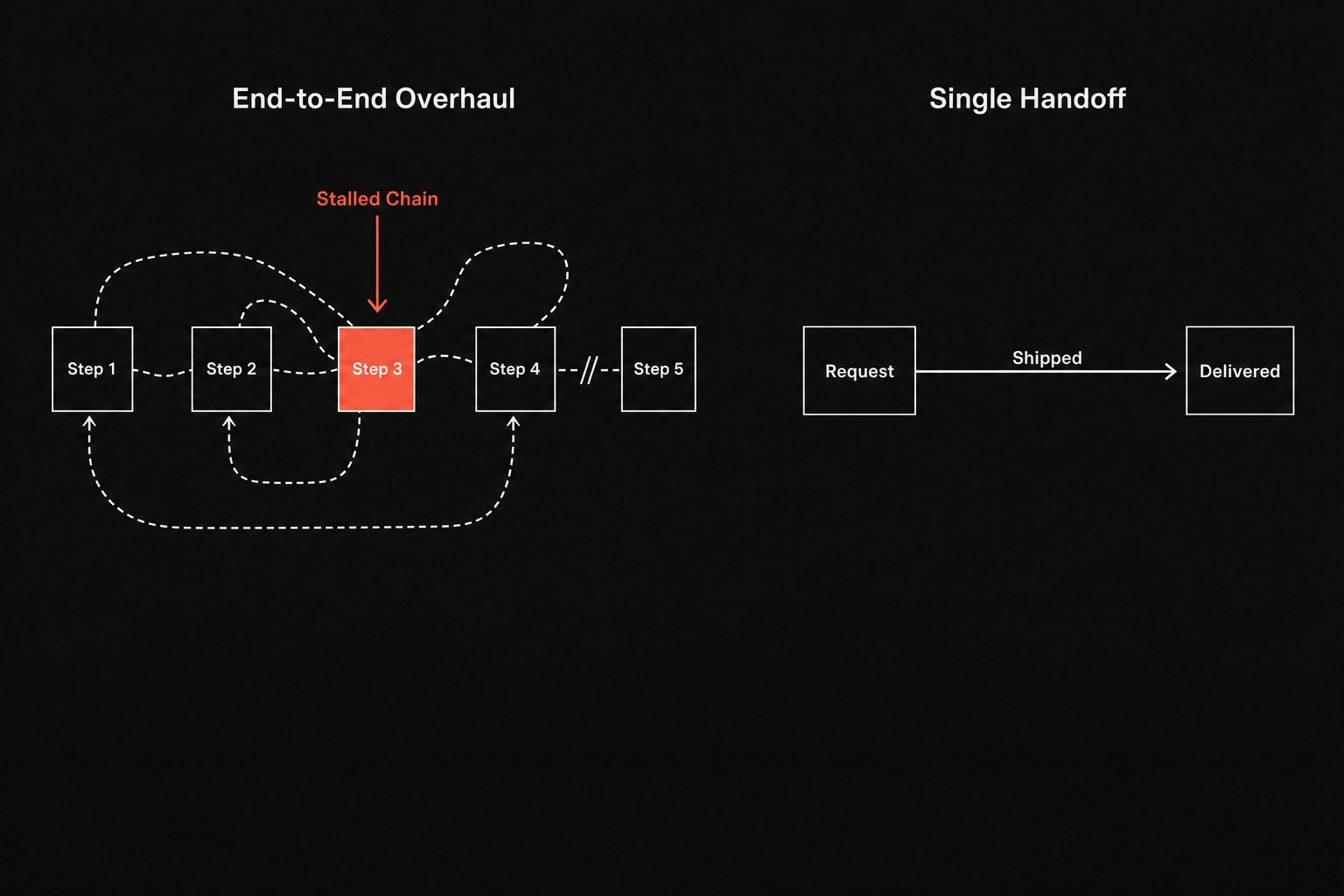
You buy hours back by shipping one isolated handoff (one payload crossing from one person or system to another) that fails where someone will see it, then spending those hours on the next bottleneck.
The Lean Enterprise Institute described the same bind: people stay too busy to improve because unplanned work (rework, variation, broken information flow) consumes the hours that would have removed the unplanned work. In a service shop that looks like:
- Re-typing a signed proposal into billing
- Chasing a missing intake field in chat
- Reconciling the project tracker against last week's spreadsheet
If you cannot name those hours, run the manual tax on one pathway before you pick a tool. If the step still has no shared rule for what a finished record looks like, fix the process first. Those two checks decide whether you are allowed to build this week.
You will not get a quiet quarter
Ops calendars that wait for "after this busy season" are lying to themselves. There is always another close and another client who needs a custom path, so the overhaul plan becomes a parking lot for the same paste that already costs you every Tuesday.
A multi-month rebuild fails while you map five systems, because the live exceptions keep changing the map. The program finishes against a process that no longer exists, or it never finishes because the people who know the exceptions cannot leave the queue long enough to sit in the workshop.
Ship one isolated handoff while the rest of the firefight continues. You are buying a few hours next week, not a new operating model, and that is the only increment a team in triage can actually keep.
The usual version is a quarter spent documenting "lead to cash" while the coordinator still copies intake fields after every signed proposal. The document is honest on day one and stale by week three, and the paste does not stop.
Pick the handoff, not the platform
A handoff is a payload crossing a boundary: data, accountability, or a deliverable moving from one person or system to another. The sprint owns that boundary and nothing else. If you cannot draw two boxes and one arrow, the work is still a program.
Four constraints keep the build small enough to finish while the rest of the week stays ugly:
- One trigger. A signed proposal, a submitted form, or a single status change. Not
"when the account feels ready." - One payload. A fixed field list. If someone has to interpret a paragraph, you do not have a payload yet.
- One destination. Write to exactly one downstream system. Fan-out is a second project.
- One owner. One person watches the run and handles the leftovers. A shared inbox is how silent failures hide.
A five-step chain from first form to archive has too many places to break, and diagnosing it takes longer than the paste it replaced. If the fields are already stable, you can design, test, and ship a single boundary in a half day.
Price the drag before you build
Unplanned work grows every week you leave the broken step in place. Price it on last week's volume, not on how Friday felt.
Weekly Drag Hours = (Weekly Handoff Volume) × (Minutes Per Transfer) ÷ 60
Labeled example only: forty new matters a week, fifteen minutes of manual transfer each, is ten hours. Four focused hours to automate that transfer returns those ten hours the following week if the exceptions stay rare. That buffer is how you fund the next bottleneck, so use your own counts and do not import a vendor percentage.
If two handoffs look similar, pick the one with the higher drag and the cleaner field list. Volume without a rule is not a candidate. A cheap annoyance that happens twice a month can wait; a boring transfer that runs every day cannot.
Fail where someone will see it
Nobody is reading execution logs across five tools while they are also covering a vacated coordinator seat. A skipped required field or an expired key shows up as an angry customer two weeks later, or as a billing record that never landed.
If staff cannot tell whether a record moved, they keep the shadow sheet. Then they do the paste and babysit the robot, which is worse than the original tax because you now pay for both.
Require three things before you call the step live:
- Validation stops before a write if a required field is missing.
- The alert names the record id and the missing property, in the same channel the team already uses for triage.
- A written three-minute fallback exists for the halt, so the owner can finish the one record by hand without inventing a new process.
A loud failure is a two-minute exception. A quiet one is a pile of records nobody knew had stalled, and that is why the team will not drop the shadow sheet.
When not to automate in a firefight
Leave the step manual when:
- Routing changes every week by partner discretion. Wait until the rule holds for thirty days, or write the rule and then build. Software will not settle an argument the partners have not settled in person.
- The work happens fewer than five times a month, or every contract is unique. Maintenance costs more than it returns. Leave it as a written SOP and revisit if the volume shows up in the tax log.
- The CRM or project tool is being replaced in the next sixty days. Do not build connectors you will throw away. Write a temporary SOP and reopen the sprint after the cutover.
- People still disagree on what the destination record means. You are in the process article, not this one. Automating that argument only raises the volume of exception tickets your senior people already hate.
Score this week's paste
Ask three questions of each recurring paste, then take the top score that also passes the when-not tests.
- Can you count last week's volume without interviewing anyone? Yes is 1, no is 0.
- Is the payload a fixed field list with no free-text interpretation? Yes is 1, no is 0.
- If the write fails, can one named owner finish the record in three minutes from an alert? Yes is 1, no is 0.
A handoff that scores three is this week's build. A score of one or two needs measurement or a written rule first. A score of zero is still firefighting, and a silent integration will add a second job on top of the paste.
Next step
List this week's recurring pastes, compute weekly drag on each, and build the single highest-friction transfer so it fails in the open. That map-then-build, one visible handoff instead of copy-paste or a silent Zap, is the first thing Flaux runs in a workflow automation engagement.