
Every production integration between cloud software tools eventually delivers the same payload twice. If your automated pipeline creates a work order, charges a credit card, or sends an SMS confirmation whenever an incoming event arrives, your team will eventually spend hours cleaning up duplicate records.
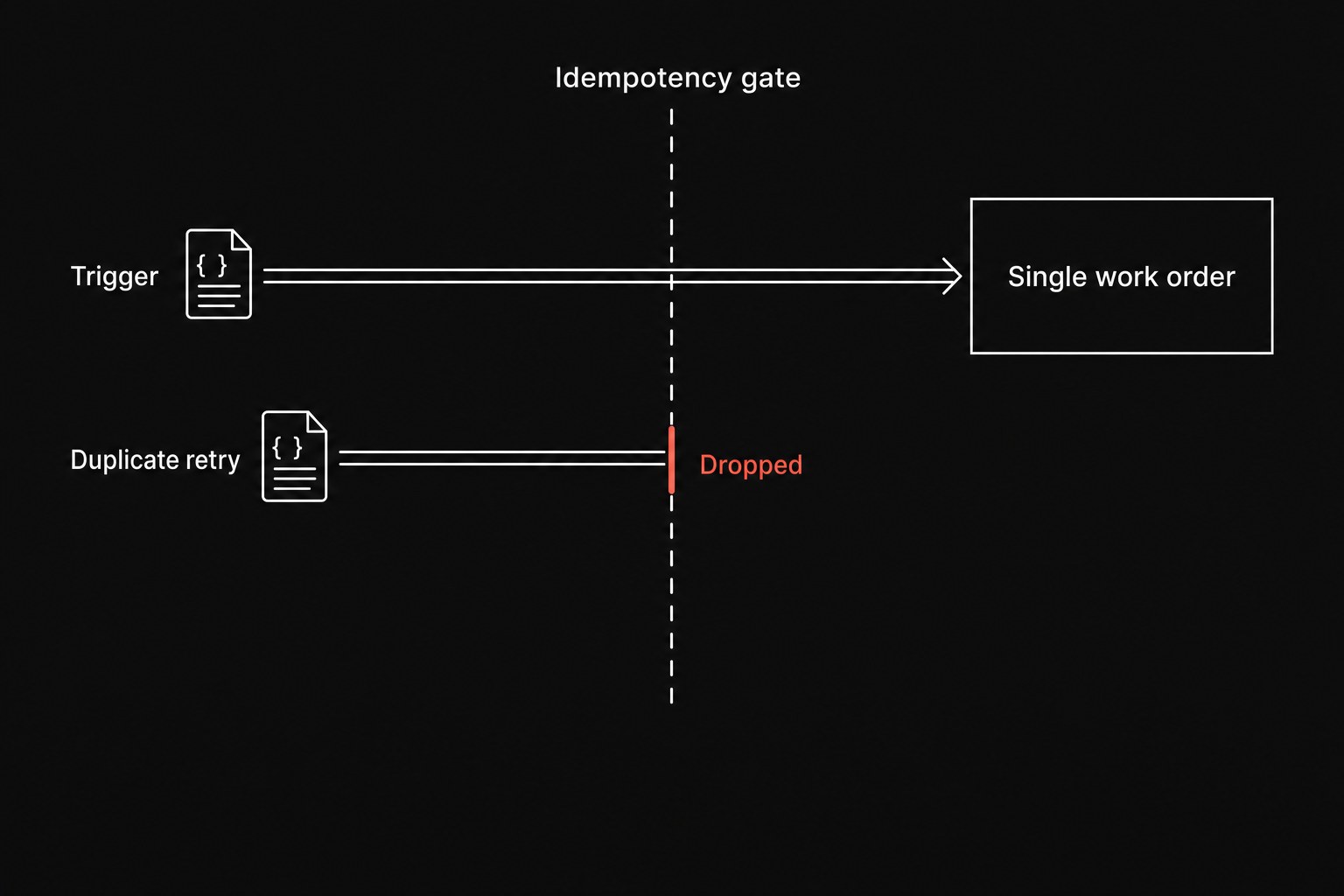
The technical term for solving this is idempotency, which means an operation produces the exact same outcome whether you run it once or ten times. When an automation lacks idempotency checks, a field tech arrives at a job site only to find a colleague already parked in the driveway asking, "Why did we dispatch two crews for the same ticket?"
To keep your operations clean, you have to treat duplicate triggers as standard behavior rather than rare technical glitches.
Why service automations fire duplicate actions
Most software providers operate on what engineers call an at-least-once delivery contract. If your CRM, scheduling portal, or payment gateway sends a webhook to your automation platform and does not receive a fast response within a few seconds, it assumes the transmission failed and sends the exact same payload again.
duplicate_frequency = event_volume × retry_probabilityWhen systems hand off tasks, duplicates happen for three basic reasons:
- Network timeouts during slow processing: Your automation receives a form submission, starts updating five systems, and takes six seconds to finish. The sending system timed out at five seconds, so it resends the entire payload thirty seconds later.
- Double clicks and form resubmissions: A customer or dispatcher clicks the submit button twice because the screen hesitated for half a second.
- Overlapping polling cycles: A scheduled integration queries your billing system every five minutes, but a long-running batch sync overlaps with the next cycle and picks up the same pending invoices.
You can read more about balancing connection mechanisms in our guide on webhooks vs polling in ops. When these duplicate events hit your automations, basic pipelines run every single action step from top to bottom.
How an idempotency check protects your system of record
A system of record is the official tool that is supposed to hold the truth, such as your ERP, field service management platform, or general ledger. A handoff is work leaving one person or system so another can continue. When a handoff happens without verification, bad data writes directly into your primary records.
An idempotent automation adds a gatekeeper step right at the trigger. It extracts a unique identifier from the incoming data, checks a persistent ledger to see if that specific ID was already handled, and halts execution immediately if a match exists.
Here is the flow of an idempotent workflow:
- Receive the payload: Extract the unique event ID, invoice number, or booking reference from the trigger.
- Query the state store: Check your database or key-value store for an existing record with that transaction key.
- Acquire a processing lock: If no record exists, write the key with a status of
in_progressso concurrent retries hitting milliseconds apart cannot pass. - Execute downstream actions: Create the job ticket, notify the technician, and generate the invoice.
- Mark completed: Update the ledger status to
completedand store the created record ID for future lookups.
If a duplicate event arrives two minutes later, step two finds the existing key and exits cleanly. The automation logs a notice like "Duplicate event ignored for order #8492" without pinging your crew or writing a twin row in your database. For broader protection across all endpoints, review our framework on automation retries and ops alerts.
Comparing duplicate prevention strategies
Different tools handle deduplication at different layers of your stack. The right choice depends on whether your destination system supports native unique constraints or relies purely on your workflow logic.
| Approach | Where It Runs | Best Used For | Trade-offs |
|---|---|---|---|
| Trigger Deduplication | Automation Engine (n8n, custom worker) | Webhook-heavy flows, multi-app handoffs | Requires a persistent datastore (Redis, Postgres) to track processed keys. |
| Database Unique Keys | System of Record (PostgreSQL, ERP) | Customer records, invoice tables | Rejects duplicates hard, but automation workflows must handle the resulting error gracefully. |
| Lookup-Before-Create | API step inside workflow | Low-volume forms, simple SaaS syncs | Adds an extra API call per event; vulnerable to race conditions if two events run simultaneously. |
| Native Idempotency Keys | Destination API (Stripe, Modern APIs) | Financial transactions, card charges | Only works if the receiving vendor API natively accepts an Idempotency-Key header. |
When not to build custom idempotency logic
Not every automated workflow requires a dedicated state store or complex deduplication logic. Adding extra verification steps increases workflow complexity and maintenance overhead.
You can safely skip building custom idempotency layers under these conditions:
- Read-only query workflows: If your automation only fetches daily metrics and posts a summary message into a private channel, duplicate executions produce no permanent data corruption.
- Pure upsert operations: If your destination endpoint supports upserts (update if exists, insert if new) based on an immutable external ID, running the workflow twice simply overwrites the record with the same values.
- Single-threaded batch queues: If you process events sequentially through a single message queue where retries are strictly managed after complete pipeline failures, concurrent duplication risks are minimal.
If your automation creates child records, charges money, sends external customer emails, or triggers dispatch logistics, idempotency is mandatory.
Next step
Preventing duplicate work orders requires mapping each handoff across your systems and replacing fragile, silent triggers with resilient orchestration that logs every key. Flaux designs and builds production workflow automations that handle retries, deduplication, and failure alerts cleanly.