
In a professional services firm, moving an opportunity to closed-won creates an immediate operational fracture between the sales pipeline and the delivery schedule. Sales teams run on deal stages, total contract values, and sign-off dates inside HubSpot or Salesforce, while project managers live inside Asana, Monday.com, or ClickUp tracking work breakdown structures, assigned hours, and milestones.
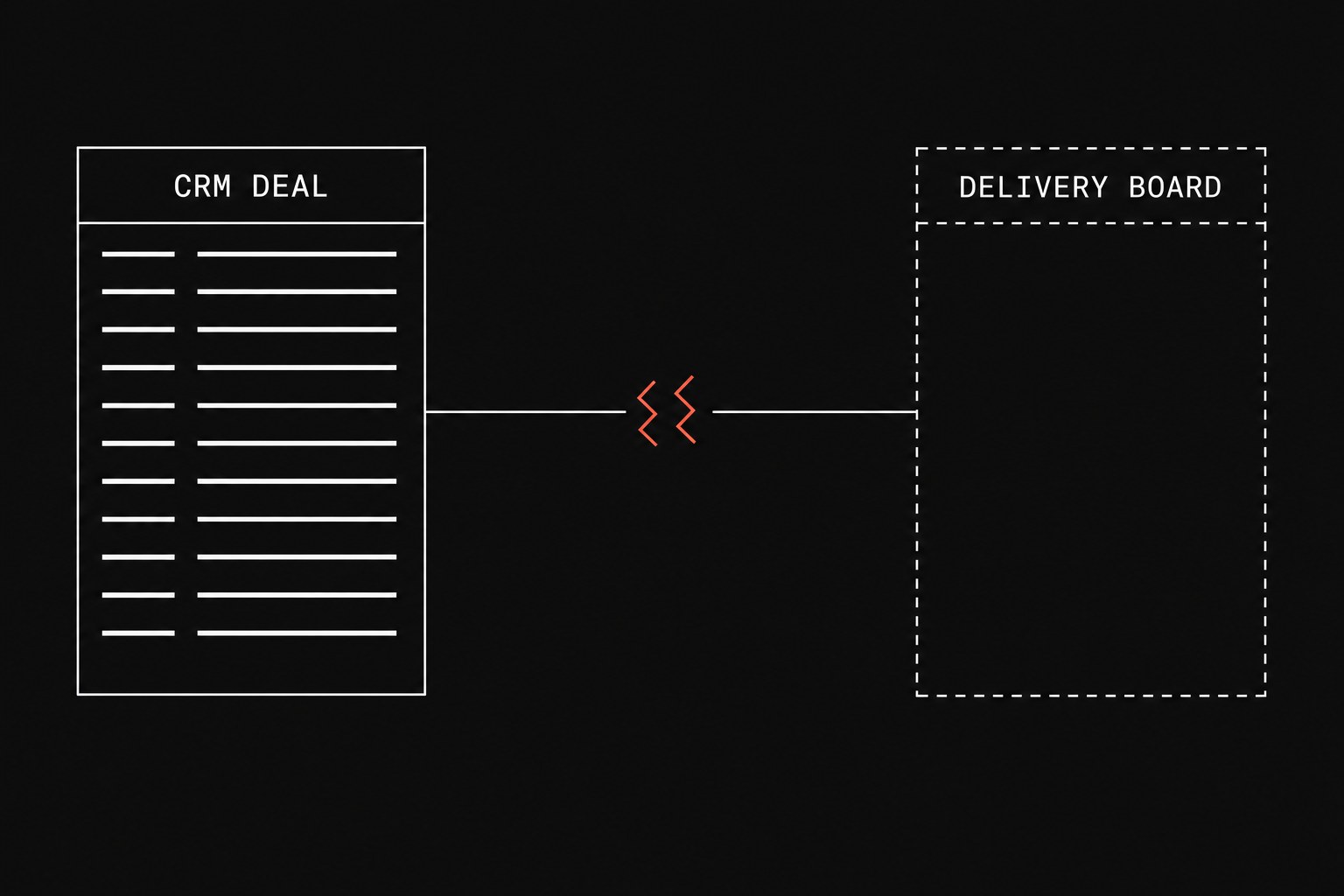
Native connectors promise seamless transitions, but they rarely pass anything beyond the deal name and a primary contact email. This leaves your delivery leads hunting for signed statements of work, guessing at customized scope inclusions, and retyping line items across systems before client kickoff can even begin.
When an organization scales past twenty people, this handoff, defined as work leaving one person or system so another can continue, quickly degrades into operational noise and untracked scope creep. Most firms discover that their CRM cannot serve as the single system of record, the official tool that is supposed to hold the truth, for both revenue pipeline metrics and day-to-day project milestones.
Without a reliable bridge between these applications, organizations experience severe disconnects where ops tools share no real-time events, leading teams to maintain shadow documents and create competing sources of truth between CRM records and field spreadsheets.
What breaks during the standard closed-won handoff
Default native connectors treat a won deal as a simple notification trigger rather than a complex translation of scope. A standard recipe might spin up a fresh project board when an opportunity hits 100% probability, but it dumps an empty shell into your tracker that lacks the operational context agreed upon during negotiations.
Delivery setup cost per month = monthly deals won × 4.5 hours of manual adminThe friction typically surfaces in four distinct places:
- Custom line items get flattened into a single contract lump sum, hiding agreed-upon deliverables and task boundaries from the delivery manager.
- Tiered milestone dates and billing triggers recorded in the contract remain trapped inside CRM properties or attached PDFs.
- Resource allocations and projected hours stay in sales spreadsheets rather than transferring directly to staffing schedules.
- Client onboarding questions answered during discovery get lost, forcing account managers to ask the client the exact same questions on the kickoff call.
When project managers do not have direct visibility into these details, they ask standard questions in Slack like "Where is the final signed SOW?" or "Did we promise weekly status calls in this tier?" Every hour spent tracking down those answers delays billing realization.
Comparing native sync against true event orchestration
Most service companies attempt to resolve this breakdown by installing off-the-shelf app marketplace plugins or basic two-step webhook recipes. These work adequately for uniform, five-person agencies where every client purchases an identical fixed-scope package, but they collapse when a mid-market firm introduces variable staffing models, change orders, or tiered retainer phases.
| Capability | Native marketplace plugin | Point-to-point webhook | Orchestrated event workflow |
|---|---|---|---|
| Project board creation | Creates empty template | Creates project with static tasks | Generates custom task hierarchy based on line items |
| Attachment routing | Leaves PDF in CRM deal | Uploads raw file to root folder | Extracts scope clauses and links signed SOW to kickoff task |
| Dynamic resourcing | None | Static assignment to one owner | Assigns tasks by discipline and role capacity |
| Milestone reconciliation | One-time trigger on close | One-way status update | Two-way sync across invoice checkpoints and delivery gates |
| Handling custom scope | Ignored completely | Requires manual field mapping | Parses contract products to construct deliverable board |
A native plugin merely informs delivery that a contract was signed. A structured event-driven workflow translates the commercial terms into an actionable operational backlog.
How to structure an automated delivery handoff
Bridging the gap between your CRM and your project tracker requires treating the closed-won transition as an orchestration process rather than a single field toggle.
A production-grade handoff workflow follows five concrete stages:
- Validation gate: The workflow verifies that mandatory deal properties exist before triggering project creation. If the signed contract PDF, primary billing contact, delivery tier, or kickoff target date is blank, it alerts the sales rep immediately instead of passing partial data down the line.
- Entity provisioning: The automation provisions the workspace in your project tool, applies naming conventions, and logs the CRM Deal ID as a custom field to maintain a permanent relational key between both platforms.
- Line-item task generation: Instead of applying a generic template, the workflow reads the deal line items or quote tables, dynamically generating specific task groups, allocated budget hours, and deliverable checklists for each purchased service component.
- Context transfer: Discovery notes, technical questionnaires, and signed documents are parsed and attached directly to the kickoff task, giving the delivery lead full context without requiring CRM login credentials.
- Bidirectional feedback: When the delivery team completes the project onboarding milestone in their tracker, a webhook updates the CRM deal stage to active delivery, notifying the account executive that kickoff was completed on schedule.
When not to automate this handoff
Automating the CRM-to-tracker handoff is not the right decision for every service business. You should hold off on building custom orchestration in any of the following scenarios:
- Bespoke, unstandardized service lines: If every engagement is priced and delivered under a completely unique operational model with zero repeatable milestones, building automated task generation creates rigid project boards that delivery leads immediately delete.
- Low deal volume with high contract value: If your firm closes fewer than two enterprise contracts per month, spending administrative time to manually configure complex boards is significantly cheaper than maintaining custom API integrations.
- Unstable sales stages: If your account executives routinely mark deals as closed-won before contracts are countersigned, or if deal properties are updated erratically post-sale, an automated pipeline will simply push bad data into your delivery queue faster.
If your delivery models are standardized and your volume exceeds five deals per month, leaving this handoff unautomated guarantees administrative bloat and unbilled scope leaks.
Next step
Map the five fields and three attachments that your delivery leads consistently request from sales after a deal closes. If your team spends more than three hours per deal manually building project boards and re-entering scope details, an operational AI assessment with Flaux identifies the exact workflow bottlenecks across your CRM and delivery tools to determine whether targeted automation or process refactoring will yield the fastest return.